
Jin Jun Mei Tea: The Ultimate Guide to 7 Core Truths Behind This Luxurious Black Tea Gem

In the brilliant constellation of Chinese black teas, Jin Jun Mei Tea shines like a supernova, redefining the boundaries of premium black tea with its unparalleled purity, sweetness, and elegance. Born in 2005 in the remote Tongmu Guan of Fujian’s Wuyi Mountains, this masterpiece made exclusively from early spring single buds quickly captivated the palates of connoisseurs worldwide. But what exactly is Jin Jun Mei? Why is it so precious? And how does one appreciate its essence? This article delves into 7 core truths about Jin Jun Mei Tea, from its legendary origin and exacting craftsmanship to its sublime flavor, offering a complete guide to this “Hermès of black teas.”https://junxistea.com/product/jin-jun-mei-black-tea/
1. Definition & Heritage: What is Authentic Jin Jun Mei Tea?
First, a crucial definition must be established: authentic Jin Jun Mei Tea is a strictly protected Geographical Indication product, not a generic name. It specifically refers to the supreme black tea produced in Tongmu Guan and surrounding high-altitude areas within the Fujian Wuyi Mountain National Nature Reserve, using only the early spring single buds of local native tea bush varieties (commonly called “Caicha”), and refined through a specific, innovative process.
It is the direct descendant and pinnacle expression of the world’s black tea ancestor—Lapsang Souchong. While 400-year-old Lapsang Souchong is known for its pine-smoke aroma and dried longan taste, Jin Jun Mei was created in the early 2000s by a team of Lapsang Souchong inheritors. Its revolutionary aspect lies in completely abandoning the traditional “strong and red” style and pine-smoke roasting, instead pursuing an ultimate taste profile of elegance, fresh sweetness, and high aroma, ushering in a new era of “clear-drinking black tea.” Understanding this is fundamental to discerning the many imitations on the market.
2. Decoding the Name: The Profound Meaning Behind “Jin, Jun, Mei”
The three characters “Jin Jun Mei” are a poetic condensation of its identity and quality, each carrying rich meaning:
• 金 (Jin – Gold): First, refers to its dry leaf appearance—tight, slender buds densely covered in golden pekoe, shining like golden threads under light. Second, signifies its precious rarity; tens of thousands of early spring single buds are needed to produce just 500g of dry tea, making its value comparable to gold.
• 骏 (Jun – Steed): Commemorates its creation year, 2005 (the Chinese Year of the Wood Rooster, or “Jin Jun” year in some contexts), implying its birth carried the机缘 of the era and masterful craftsmanship. It also symbolizes the tea’s swift rise to fame, galloping like a steed to become a new benchmark in the black tea world upon its debut.
• 眉 (Mei – Eyebrow): Vividly depicts the shape of its raw material. The tea buds are slender, elegant, and curved like fine eyebrows, representing the concentrated essence of the tea plant. In ancient times, “Mei” was also used to denote premium tea, as in “Shou Mei.”
3. The Gift of Terroir: Tongmu Guan, The Irreplicable Cradle
The excellence of Jin Jun Mei Tea is first rooted in its irreplicable place of origin—Tongmu Guan in the Wuyi Mountains. This core area, designated a UNESCO World Cultural and Natural Heritage site, is the ideal terroir for supreme tea growth.
3.1 The Ultimate Ecological Environment
Tongmu Guan has an average altitude of over 1000 meters, with forest coverage reaching 96.3%, making it a veritable “natural oxygen bar.” The area is perennially misty, receives abundant rainfall, and has significant diurnal temperature variation. The unique diffused light, extremely high air humidity, and organic-rich, acidic red-yellow soil collectively shape the tea leaves, giving them rich inner substance, high amino acid content, and a pure, wild mountain character. With minimal pests and diseases, tea plants require no pesticides, ensuring the tea’s purity and safety from the very source.
3.2 The Ancient Tea Lineage
The tea plants grown here are not high-yield, clonal cultivars, but the genetically diverse native “Caicha” (tea bush) population, naturally acclimatized over centuries. These tea trees have deep roots in rocky crevices, grow slowly, and absorb the essence of their environment. Their spring buds, though yielding very little, accumulate more complex, harmonious aromatic and taste compounds, forming the foundation for Jin Jun Mei’s unique “rock rhyme” and mellowness. Without this specific landscape and these ancient trees, the “soul” of Jin Jun Mei is lost.
4. The Ultimate Craft: The Artisan’s Journey of Tens of Thousands of Single Buds
If terroir provides the soul of Jin Jun Mei Tea, then its pinnacle handcrafting process gives it flesh, blood, and structure. Its production is the ultimate test of patience, skill, and intuition.
4.1 The One-in-Ten-Thousand Pluck
About half a month before the Qingming Festival each year, tea pickers enter the deep mountains and, while the morning dew is still wet, use their fingertips to gently pluck the plumpest, fullest single bud from the top of each tea shoot. The standard is strict: “a single bud with no leaf,” and the buds must be even and rich in pekoe. A skilled worker can only pick about 2,000 buds in a day. Producing 500g of top-grade Jin Jun Mei requires approximately 60,000 to 80,000 such buds. The picking cost and scarcity are self-evident.
4.2 The Wisdom of No-Rolling & Precise Oxidation
Unlike traditional black tea, which is vigorously rolled to accelerate oxidation, the core of Jin Jun Mei’s process is “preserving form” and “enhancing aroma.” Drawing from some oolong tea “bruising” principles, it employs gentle rocking/tumbling and withering to allow the buds to slowly and evenly initiate enzymatic oxidation through slight water loss and cell wall breakage. The entire process involves no rolling, maximally preserving the buds’ intact form. Controlling the oxidation level is key to the final flavor. Masters rely on experience to halt oxidation precisely at the threshold where aroma is most lifting, sweetness is most pronounced, and bitterness/astringency are nearly absent, typically resulting in a lighter oxidation level than traditional black tea.
4.3 Slow Drying Over Gentle Heat
The final drying is not mere dehydration but a process of slow, patient “baking” over low-temperature charcoal or controlled hot air. This step further stabilizes the formed aromatic compounds, developing sweeter “honey” and “baked sweet potato” notes, while making the buds tight and enhancing the pekoe. The entire process is time-consuming, relying entirely on the tea master’s sight, touch, and smell—a true art of experience and craftsmanship.
5. A Sensory Feast: How to Professionally Appreciate a Cup of Jin Jun Mei
Appreciating Jin Jun Mei Tea requires engaging all senses, following the steps of “Observe the form, Inspect the color, Smell the aroma, Savor the taste, Admire the leaves.”
5.1 Observe Form & Color
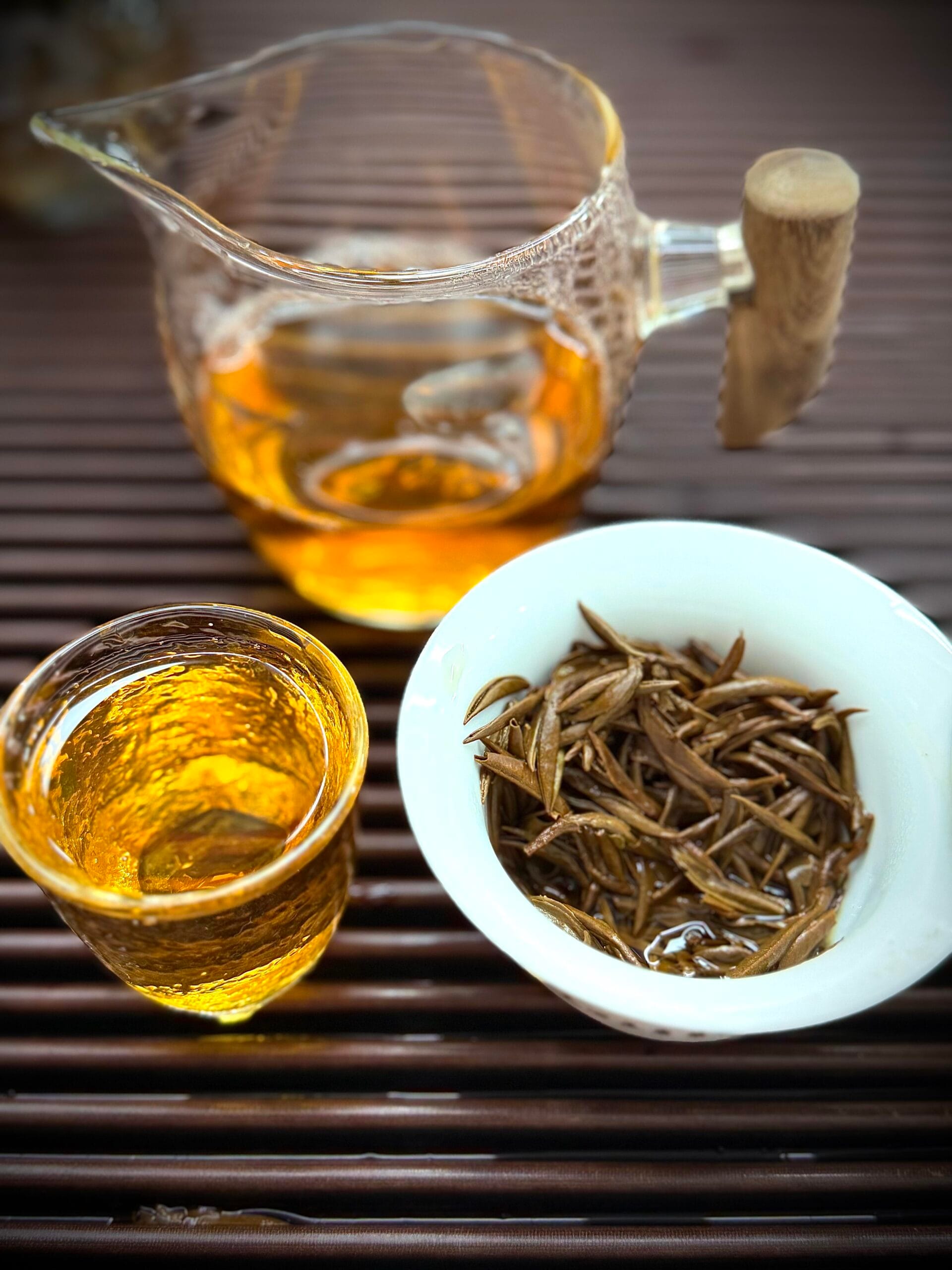
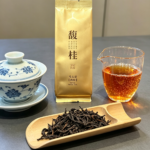
• Dry Leaves: The strips are tight, slender, and curved like eyebrows, with a ratio of “three parts golden, seven parts dark,” interwoven with gold, yellow, and black, with visible golden pekoe and a glossy sheen.
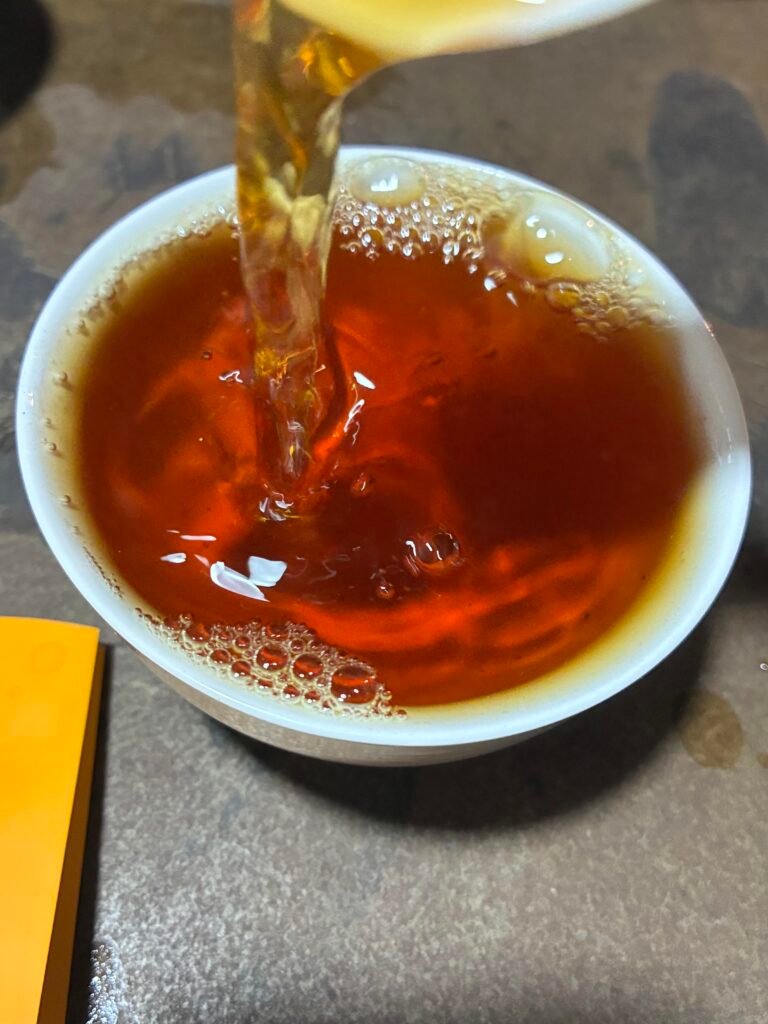
• Liquor: Brewed with 90-95°C water, the liquor is not deep red but a golden-yellow or orange-yellow, bright and translucent, with a golden ring, indicating high clarity—a hallmark of its light oxidation and pure buds.
5.2 Smell Aroma & Savor Taste
• Aroma: When hot, the aroma is elegant, lasting, and complex—floral, fruity, and honeyed. The dominant note is a pure honey sweetness, intertwined with fresh orchid fragrance, sweet potato scent, and a hint of the mountain’s characteristic clean, grassy note, with no off-odors or roastiness. After the cup cools, the honey scent condenses, becoming even more lingering.
• Taste: The first impression on the palate is “clarity, aroma, sweetness, and liveliness.” The liquor is extremely smooth and brisk, with no astringency. The sweetness is not a straightforward sugary taste but a clean, fresh sweetness that quickly spreads in the mouth, stimulating strong, persistent salivation and a sweet aftertaste. The throat feel (喉韵) is deep and lasting, with fragrance lingering between teeth and cheeks, offering a satisfying sensation of warmth, smoothness, and a long finish. Its “liveliness” is reflected in the dynamic, layered evolution of the liquor in the mouth.
5.3 Admire the Brewed Leaves
The brewed leaves are the final proof of raw material and processing. High-quality Jin Jun Mei brewed leaves feature plump, full buds in a bronzy color, even and glossy, springy to the touch, like living tissue—proof of their rich inner substance.
6. The Science of Brewing: The Key to Unlocking Jin Jun Mei’s Peak Flavor
Improper brewing is a waste of premium tea. The customized brewing principle for Jin Jun Mei Tea centers on “gentle activation to reveal its true nature.”
• Vessel: First choice is a white porcelain gaiwan or thin-bodied white porcelain teapot. Porcelain doesn’t absorb flavor, most faithfully reflecting the liquor’s color and aroma, and is ideal for smelling and observing the leaves.
• Water Temperature: 90-95°C is optimal. Boiling water (100°C) is unnecessary; excessively high temperature can scald the tender buds, potentially bringing unwanted stewed notes and accelerating caffeine extraction, affecting freshness. Let boiling water sit in a sharing pitcher for about 30 seconds.
• Tea-to-Water Ratio: Recommended 1:20 to 1:25 (e.g., 3g tea for 60-75ml water).
• Brewing Method:
1. Warm the Vessel: To raise its temperature, aiding aroma release.
2. Add Leaves & Smell: Add dry leaves, swirl gently to warm them, smell the dry leaf aroma.
3. Rinse/Awaken: Pour a small amount of hot water to just cover the leaves, then immediately pour it out. The goal is to “awaken” the leaves and stimulate the initial aroma (can be discarded).
4. Formal Brewing: Use “fixed-point gentle pouring” or “circular pouring” to let the water gently saturate the leaves. For the first 3 infusions, pour immediately or steep for 3-5 seconds. High-quality Jin Jun Mei is rich in content and durable (lasting 8-10 infusions). Increase steeping time by 5-10 seconds for each subsequent infusion.
7. Conclusion: Jin Jun Mei, A Sipped Poem of Landscape
Jin Jun Mei Tea represents a magnificent contemporary bloom of Chinese tea wisdom. It inherits the 400-year-old craft lineage of Lapsang Souchong, yet with astonishing courage and mastery, transcends tradition. It no longer pursues intense stimulation or a heavy broth but pushes the essence of tea—aroma, clarity, sweetness, and liveliness—to its utmost limit.
To drink Jin Jun Mei is to sip a liquid work of art. What flows in the cup is the morning mist and mountain haze of Tongmu Guan, the vitality condensed from tens of thousands of spring buds, and the warmth and perfectionism in the tea master’s fingertips. It conquers the palate with its mellowness, soothes the spirit with its elegance, and tells you, through its enduring sweet aftertaste, the aesthetic heights that premium Chinese black tea can reach. For tea lovers worldwide, possessing a genuine infusion of Jin Jun Mei is not just a luxurious taste experience but a profound dialogue into the heart of Chinese tea culture.

My brother suggested I might like this blog.
He was once totally right. This submit actually
made my day. You cann’t consider simply how a lot time I had spent
for this info! Thanks!
Thank you so much for your kind words and support! It’s wonderful to hear that your brother’s recommendation led you here and that the article made your day. We’ll keep working hard to share more valuable tea-related content. Feel free to visit often and share your thoughts anytime!