🎄 A little something from our tea table to yours. Spend $100 or more and we'll tuck a Christmas tea gift set + holiday tote into your parcel — no code needed, just our way of saying thanks. While supplies last, so don't wait till the 24th.Free Worldwide Shipping · Shipped from Fujian, China. Enjoy hassle-free delivery with our double customs clearance service—all taxes prepaid, no hidden costs! Specializing in High-Quality Chinese Tea & Teaware. Our teas feature authentic flavors, sourced from the best farms and purely handmade by master artisans without any additives. Experience the true essence of traditional tea culture today. DismissSkip to content
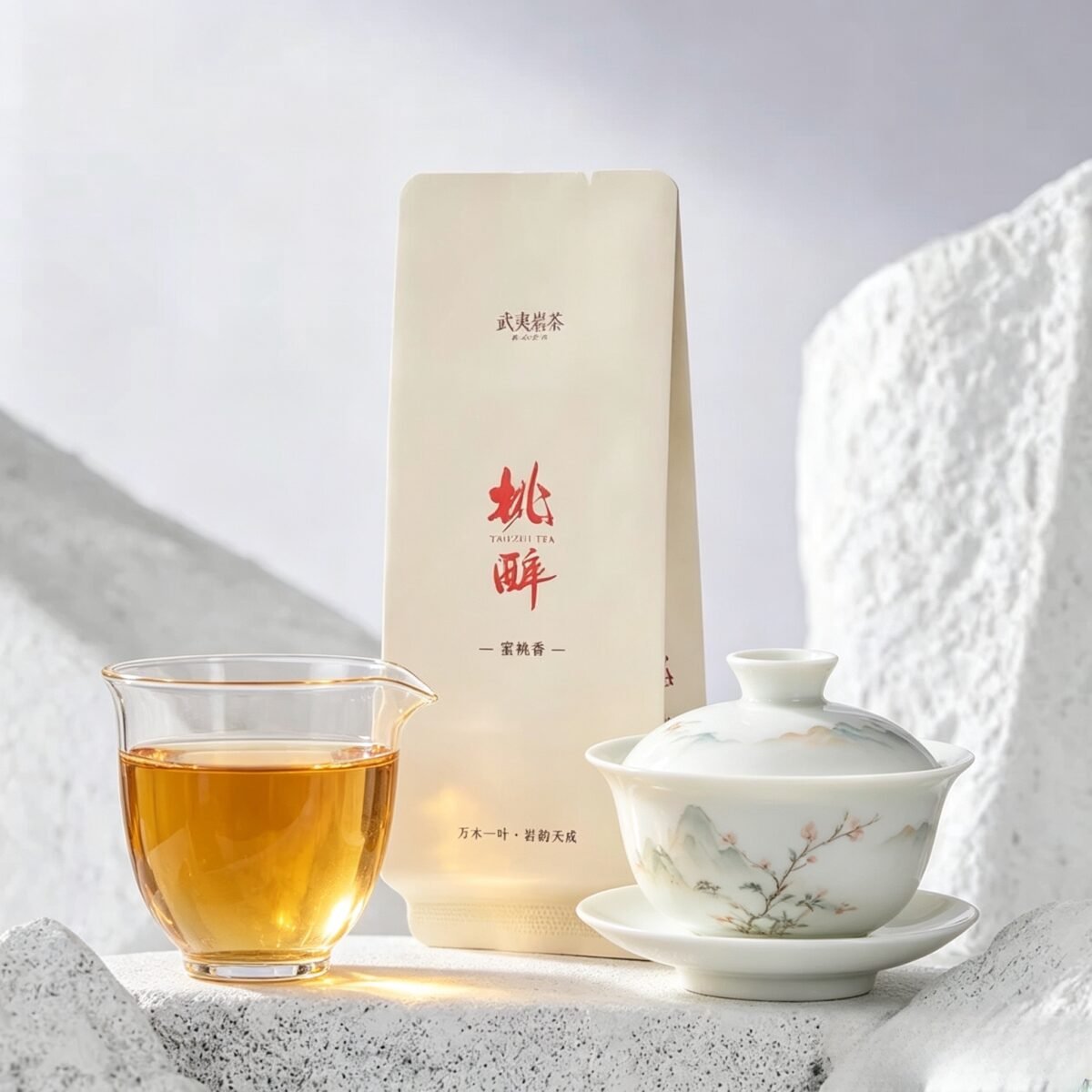
Natural peach aroma oolong gives you ripe peach sweetness that comes from the tea plant, not from syrup or perfume. This season’s light-ferment spring lot is hand-plucked, gently oxidized, and never touched by flavoring oils. The cup is silky, low in bitterness, and refreshes for 5 to 7 steeps. Two sizes available, ships free worldwide with customs cleared before delivery.
Natural peach aroma oolong: the fruit scent that grows on the bush
Natural peach aroma oolong is not a peach-flavored blend. It is a lightly oxidized oolong whose leaves carry a ripe peach fragrance straight from the cultivar, awakened through careful leaf-shaking and low-temperature finishing. When you open the pouch, the dry leaf smells like a peach orchard in late spring, not like candy or perfume.
This season’s lot is picked in early spring, when the buds and young leaves still hold high amino acids and the orchard below the terrace is just beginning to bloom. The leaves are tightly rolled, sandy green with a faint jade edge, and they carry an oily sheen that only appears when the leaf is handled gently. There is no powder, no broken dust, no artificial gloss.
Why “natural” is the whole point
Most peach oolong on the market is a flavored product. The package lists dried peach, peach concentrate, or “natural peach flavoring” alongside the tea. That is a different drink. Our natural peach aroma oolong has one ingredient: Camellia sinensis. The peach note is a varietal and process aroma, the same way a fine Tieguanyin can smell of orchid without any flower added.
You can test it yourself. Rub a few dry leaves between your fingers. Real leaf aroma stays in your skin as a soft fruity warmth. Flavored leaf leaves a sharp, almost chemical top note that fades in seconds. Brew it, and the peach rises from the cup, settles into the soup, and lingers on the empty cup after you finish, the way a good white wine leaves a trace of stone fruit on the glass.
Spring harvest light oolong: how the season shapes the cup
Spring is the best window for a delicate, fruity oolong. After the winter rest, the bush stores nutrients in the root, and the first flush carries more theanine, more aromatic precursors, and fewer harsh tannins. That is why our natural peach aroma oolong is built only from this season’s early spring picking.
The leaves go through a gentle oxidation of roughly 20 to 30 percent. This is lighter than a rock oolong and far lighter than a black tea. Light oxidation keeps the green freshness while letting the fruit character bloom. Too little oxidation and the peach stays hidden behind grassy notes. Too much and you drift into baked-fruit territory that belongs to a heavier roast. We stop right where the leaf smells like a peach that is still firm to the touch.
Hand-plucked, hand-sorted, gently finished
We avoid the word “hand made” because it has become meaningless in tea marketing. Here is what actually happens: the leaf is hand-plucked by families who know which shoot to take and which to leave. It is hand-sorted to remove any stem or imperfect curl. Then it is finished in small batches where the master reads the leaf by smell, not by a timer.
The rolling is done slowly so the pearl or curly shape closes without crushing the aromatic oils. The final drying is low and patient, preserving the volatile compounds that give you peach instead of toast. A machine line cannot make these calls. It can copy the shape, but it cannot copy the smell.
The leaf, the curl, and the color
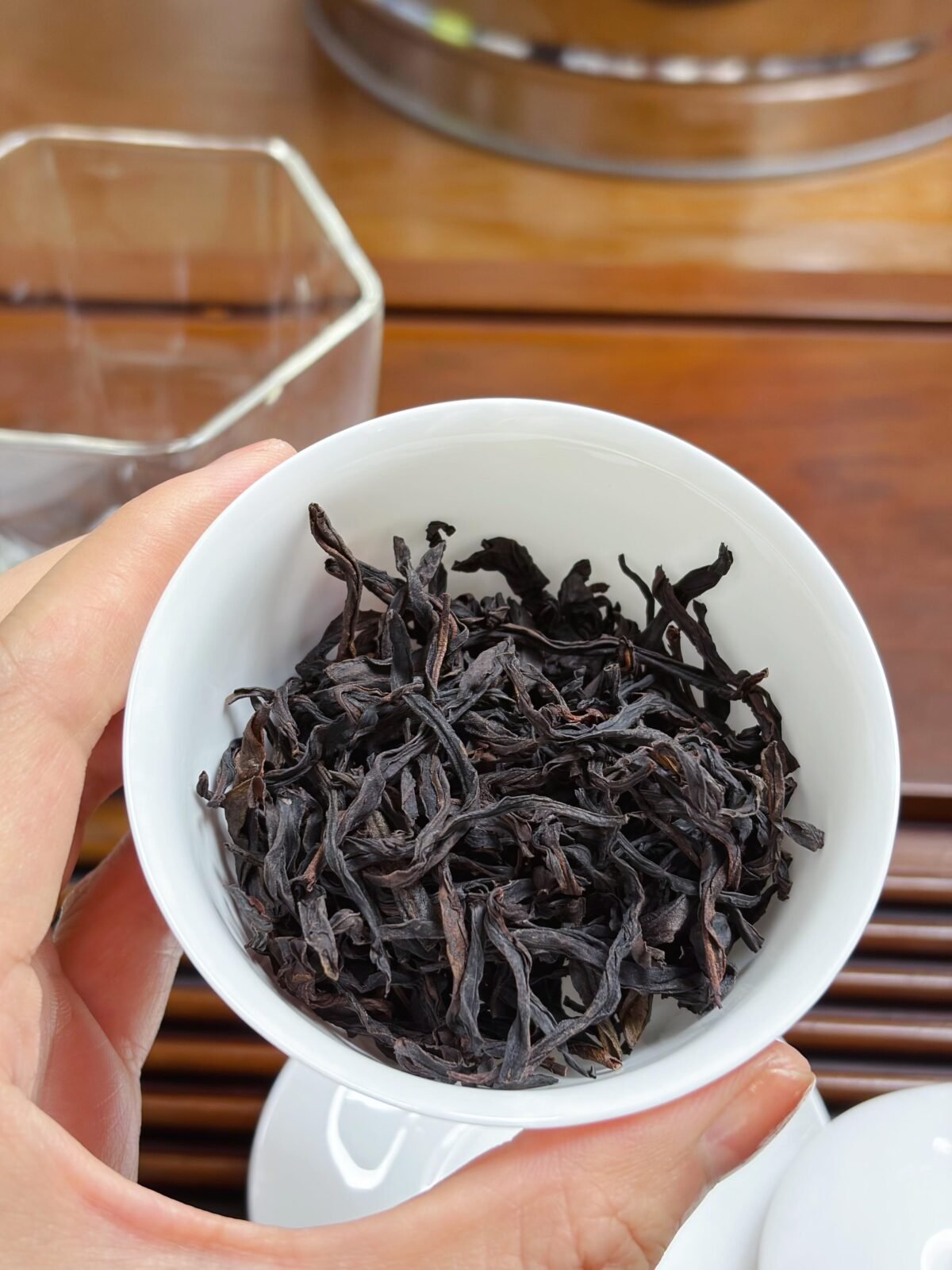
Depending on the batch, the dry leaf is either a tight pearl or a slender curl. Both are correct for this tea. What never changes is the color: a sandy green with翠 (jade) highlights and a quiet oil shine. If the leaf looks flat, uniform, and unnaturally bright green, it has been over-fired or dyed. Ours looks alive, with slight variation from pearl to pearl, because each one was touched by a hand.
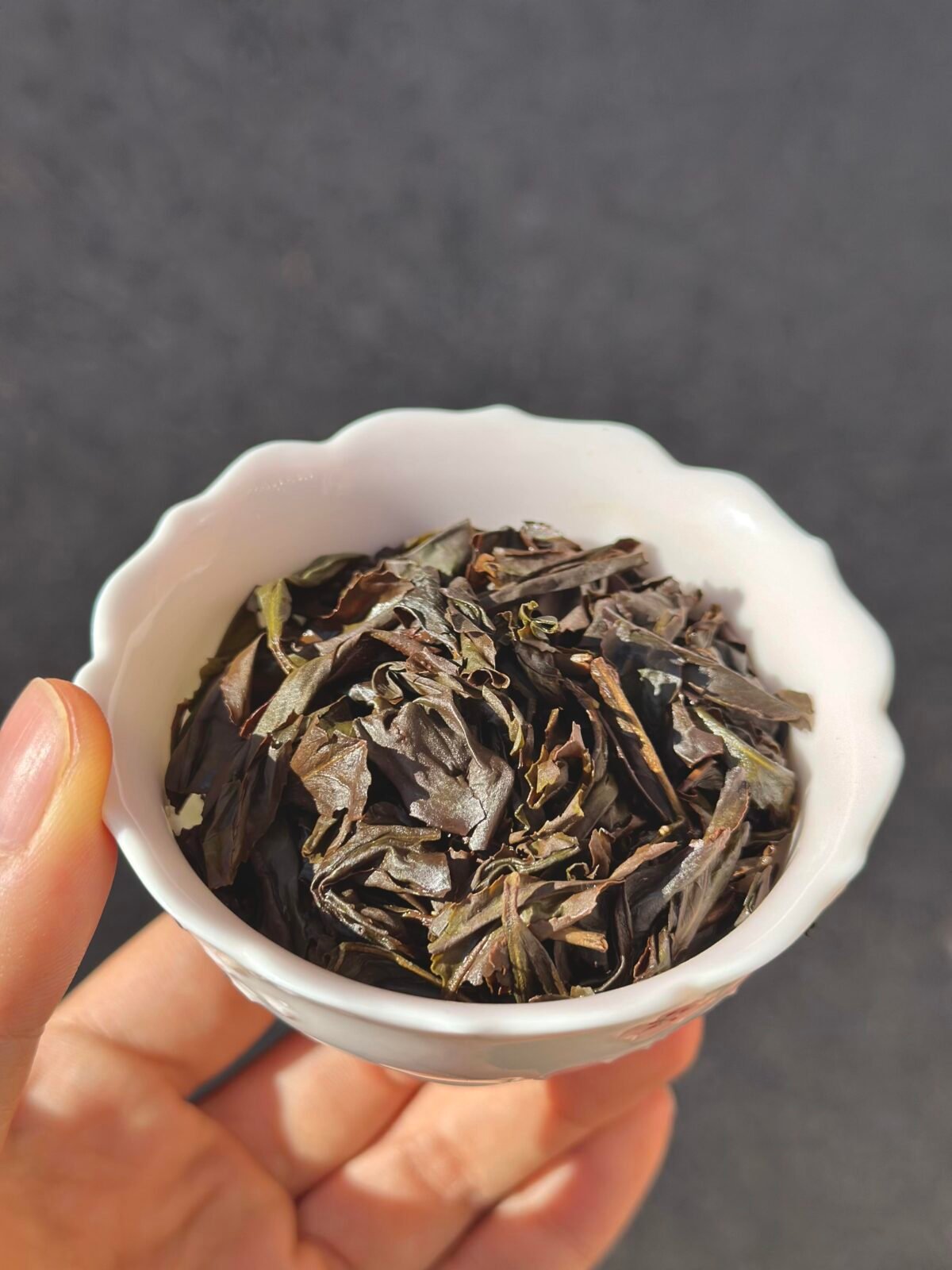
Once water hits the leaf, it unfurls into a full, supple blade with a faint red edge, the classic “green leaf, red rim” of a well-made oolong. The soup is honey-gold to pale jade, never cloudy, never brown. Hold the cup to the light and you should see through it clearly.
Tasting natural peach aroma oolong: a three-act pour
The aroma hits before the taste. Dry leaf: ripe peach skin, a whisper of cream, and a green lift underneath. Wet leaf: the peach deepens, joined by nectarine, a touch of honeysuckle, and a cool mineral finish that keeps it from being sweet in a dessert way.
First sip is silky and almost juicy. The peach is not a topping, it is woven into the texture. Mid-palate brings a soft body, like biting into the flesh of a white peach with the skin still on. The finish is clean, with a faint cooling sensation at the back of the throat and a sweetness that asks for the next sip.
Why it is not bitter or astringent
Light oxidation plus careful low-temperature drying keeps the catechins in check. The tea feels round rather than sharp. Even if you accidentally steep it a little long, it softens instead of clamping down on your tongue. That is what makes natural peach aroma oolong such an easy daily drinker, especially for people who say they “don’t like bitter tea.”
Over five to seven steeps the character moves: steeps one and two are bright and fruity, three and four turn creamy and floral, five through seven settle into a quiet stone-fruit sweetness with a mineral tail. You are not chasing a single perfect cup. You are watching one leaf tell a short story.
Brewing natural peach aroma oolong, hot and cold
For the gaiwan method, warm a 110ml gaiwan. Add 7 to 8 grams of leaf. Water at 90 to 95°C, never boiling, because the tender spring leaf will scald and turn the aroma flat. First rinse is optional and quick, just to open the pearls. Then pour and drain immediately for the first three steeps, around 5 to 8 seconds each.
From the fourth steep, add 5 to 10 seconds per round. The leaf keeps giving because the roll is tight and the oxidation is balanced. Use the lid to trap the aroma, lift it after pouring, and smell the lid first. That is where the peach lives most clearly. A gaiwan or a small Yixing-style pot both work; the small vessel keeps the concentration high so the fruit stays loud.
Why this rhythm? The outer layer of the leaf releases fast, so early steeps should be short. As the roll opens, the inner leaf needs more time to speak. Push too hard too early and you pull out only surface aroma and a little bitterness. Stay patient and the tea rewards you with a slow, layered arc.
For the Western cup, use a 300ml mug with 3 grams of leaf and water at 90°C. Steep 2 to 2.5 minutes and strain. You will get two full mugs, maybe three, softer and rounder than the gaiwan version but still clearly peachy. This is the method for a desk, a book, and a slow afternoon.
Cold brew: where this tea truly sings
Unlike a heavy-roast oolong, natural peach aroma oolong is built for cold water. Take a 500ml jar, add 5 grams of leaf, fill with cold filtered water, and rest it in the fridge for 6 to 8 hours. No heat, no rush.
Cold extraction pulls the fruit aromatics while leaving behind most of the tannin. The result is a crystal-clear peach cup, more like biting into a chilled white peach than drinking tea. The cream note disappears, the citrus lift stays, and the finish turns更长 (longer, but we keep it English: more extended). It is low-acid, naturally lightly caffeinated, and honestly hard to stop sipping.
Cold brew also solves the “is it flavored?” doubt. A scented or oil-sprayed leaf tastes hollow when cold. Our leaf tastes fuller cold than hot, because the fruit was always in the leaf.
Light oolong vs flavored oolong: a buyer’s check
If you have only met peach oolong as a tea-bag blend with dried fruit pieces, this will surprise you. Here is the difference in plain terms:
Flavored peach oolong smells loud in the bag and fades after one steep. The aroma sits on top of the tea like a perfume. Natural peach aroma oolong smells quieter dry, louder wet, and deeper with every steep. The peach is in the broth, not on the leaf.
Check the ingredient list. If it says “peach flakes, flavoring, essences,” you are buying a flavored blend. If it says “oolong tea” and nothing else, and the aroma is complex, layered, and slightly different each steep, you are holding the real thing. We print the single ingredient on every pouch.
How to read the dry leaf
Real natural peach aroma oolong has uneven pearls, a living green color, and an oily touch. Fake “peach” often has uniform pellets, a dusty surface, and a smell that punches you in the face then vanishes. Trust your nose after the first brew, not before it.
Fruity oolong without flavoring: our trust anchors
No flavor oils. No fragrance sprays. No dried fruit padding. No sugar dusting. Our natural peach aroma oolong is one ingredient, sourced from a single spring picking, and sealed within days of finishing.
We do not blend old leaf into new leaf to stretch the harvest. We do not buy anonymous bulk and rebrand it. Every pouch carries the harvest season and the finishing style. If the aroma ever feels off, send it back. We would rather lose one order than fake one review.
We also never name competitors or their regions. The tea speaks for itself. What you taste is what the bush and the maker gave us this spring.
Pairing and moments: when natural peach aroma oolong fits
This is a daytime tea. Morning works beautifully, because the light caffeine plus theanine gives a clear, gentle lift without the coffee spike. Late morning with a window and some quiet is even better.
Food-wise, it loves mild sweets: almond cookies, plain sponge cake, white chocolate, fresh peaches, or a light cheesecake. It also pairs well with soft cheeses and lightly salted nuts. Avoid heavy spice, smoked meats, or dark chocolate, they bury the fruit.
Cold brewed, it replaces soda. Pour it over ice with a thin slice of real peach and a sprig of mint, and you have a zero-added-sugar drink that beats any bottled peach tea on a shelf.
Hosting with it
Serve natural peach aroma oolong to friends who say they don’t drink “serious tea.” The aroma breaks the ice before anyone takes a sip. Brew it gaiwan-style in the center of the table, pass the lid around for the smell, then pour small cups. No jargon, no ceremony pressure, just a fruit aroma everyone recognizes.
Storing your natural peach aroma oolong
Light oolongs are more fragile than roasted ones. The fruit aromatics are volatile, meaning they fade if exposed to air, light, heat, or strong smells. Keep the pouch sealed, ideally double-bagged, away from the stove, coffee, spices, and sunlight.
Room temperature is fine for short term. For longer keeping, refrigerate the sealed pouch at 0 to 5°C. When you open it, let the pouch warm to room temperature for ten minutes before resealing, so condensation does not touch the leaf.
Once opened, aim to finish it within four to six weeks. The peach will still be there, but like any fresh fruit note, it is loudest in the first month. Buy the size you can actually drink while it is at its peak.
Why vacuum sealing matters here
We vacuum-seal every pouch right after the leaf cools from finishing. Oxygen is the enemy of the peach note. The moment you cut the seal, the clock starts, but if you store it right, the first cup and the tenth cup should still smell like the same orchard.
From our hillside to your cup
Natural peach aroma oolong is a quiet kind of luxury. No heavy roast, no added scent, no noise. Just a spring leaf that happens to smell like the fruit growing below it, handled by people who know when to stop.
Every order ships free from Fujian, clears customs before it reaches your door, and arrives with a simple tasting card. No hidden fees, no tax surprises, no filler. Just tea that tastes like what it is.
Take home this season’s natural peach aroma oolong
Spring picking is limited, and a lightly oxidized fruity oolong does not improve by waiting on a shelf. Choose your size, brew it hot in a small pot or cold in a jar, and taste the difference between real leaf aroma and everything that tries to imitate it.
If you have never had a peach oolong without flavoring, this is the one to start with. Brew the first cup slow, smell the lid, and let the fruit find you.










Reviews
There are no reviews yet.