The Global Epic of a Leaf: 5 Key Moments in the 4700-Year History of Chinese Tea That Changed the World

Imagine a simple green leaf. It lacks the luster of gold, the pungency of spice. Yet, across more than forty-seven hundred years of Chinese Tea History, this leaf has toppled dynasties, rerouted global trade, and even stirred wars between empires. It has been a currency harder than coin, a diplomatic lubricant, and a state secret. Today, billions drink it daily, yet few know the epic saga behind it. This is not an article about brewing techniques, but a journey through time, exploring how Chinese Tea evolved from a medicinal herb into a civilizational icon, ultimately conquering the world.
1.Myth & Origin: From Shennong to the Era of “Eating Tea”
Every great story has a legendary beginning. The History of Chinese Tea starts with a mythical emperor, Shennong, over 4700 years ago. Legend says he tasted hundreds of herbs to identify their properties and was once struck by severe abdominal pain from poisoning. At that moment, a breeze blew a few leaves from a nearby tree into his reach. He picked them up and chewed them. Soon, the pain subsided, replaced by a refreshing sweetness in his mouth. This lifesaving leaf was from the wild tea plant. This legend establishes the foundational principle of “food and medicine sharing the same source” for the Origin of Tea in China, rooting it deeply in a culture of health and healing.https://en.wikipedia.org/wiki/Shennong
For millennia that followed, the ancients “ate tea” rather than “drank tea.” From the Zhou to the Han Dynasty, leaves were picked, dried, pounded, and then boiled with scallions, ginger, orange peel, mint, and even rice to form a thick, porridge-like “ming congee.” This primitive “tea soup” was primarily viewed as a medicinal drink for alertness, detoxification, and digestion. The trade and consumption of tea spread slowly along early merchant routes, but its form was utterly different from the clear infusion we know today. This long period of germination accumulated the most primitive experience for tea’s later refinement.
1.1 From Medicine to Taste: The First Revolution in Tea Drinking
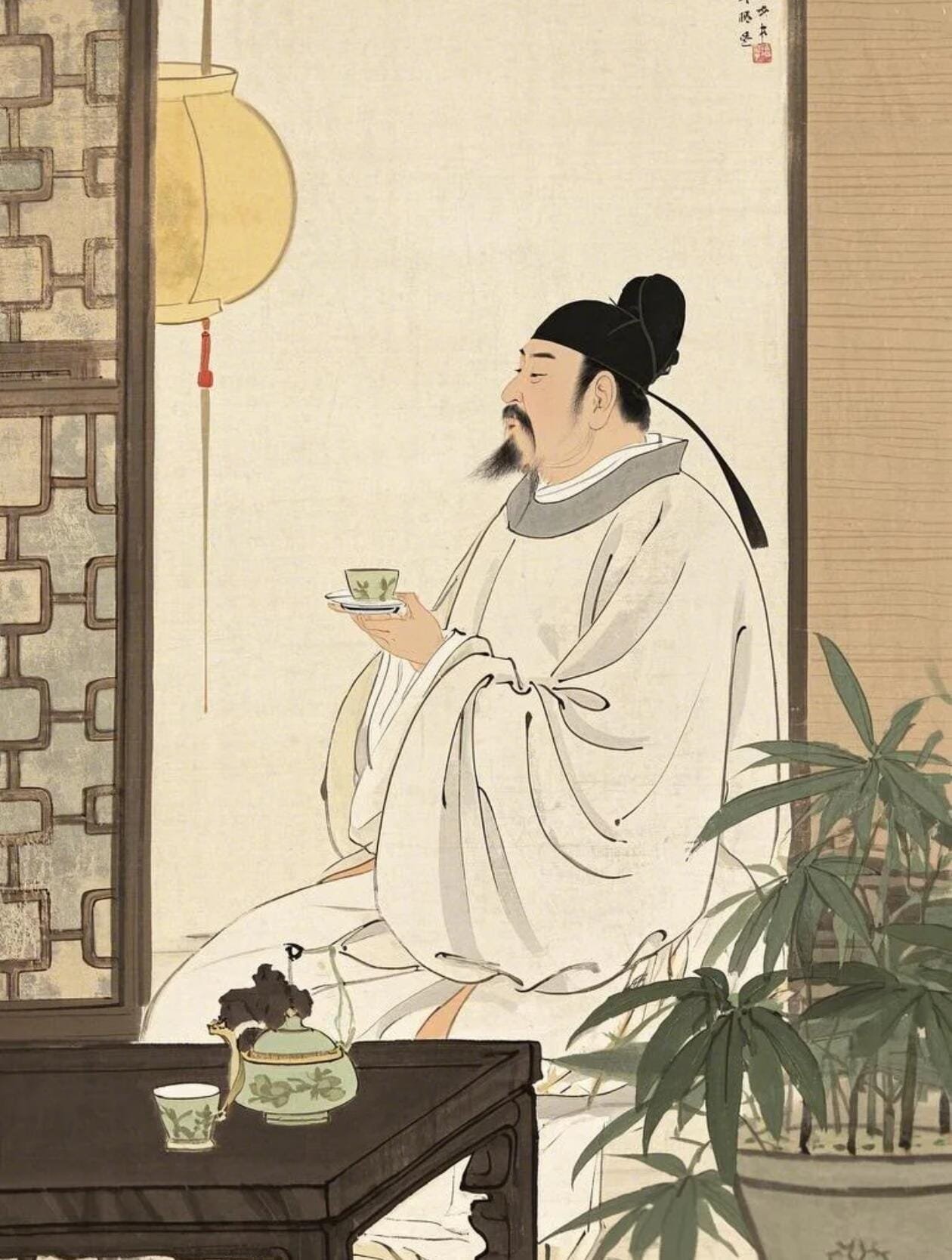
The real turning point came during the Tang Dynasty (618-907 AD). A man named Lu Yu compiled the world’s first systematic monograph on tea—The Classic of Tea. He advocated abandoning all additional flavorings, insisting on brewing carefully processed tea cakes with nothing but pure water, to savor the true taste of the leaf itself. This marked the elevation of tea drinking from a “medicinal function” to a “cultural taste” and an art form—the core of Chinese Tea Culture was born.
Lu Yu meticulously standardized twenty-four steps and tools, from picking and processing to brewing and drinking. Tea was no longer just a beverage, but a scholarly pursuit alongside guqin, chess, calligraphy, and painting. The Tang “simmering” method involved roasting tea cakes, grinding them into powder, and simmering them in boiling water, pursuing the form of the “foam” and the color of the liquor. This tradition later traveled to Japan, evolving into the root of the Japanese tea ceremony. Simultaneously, the Tea Trade began to reveal its immense strategic value. The nomadic peoples of the north, with their greasy diet, developed a rigid demand for tea’s digestive properties.
2. The Imperial Drink: Tea as a Pillar of Culture & Economy in the Tang & Song Dynasties
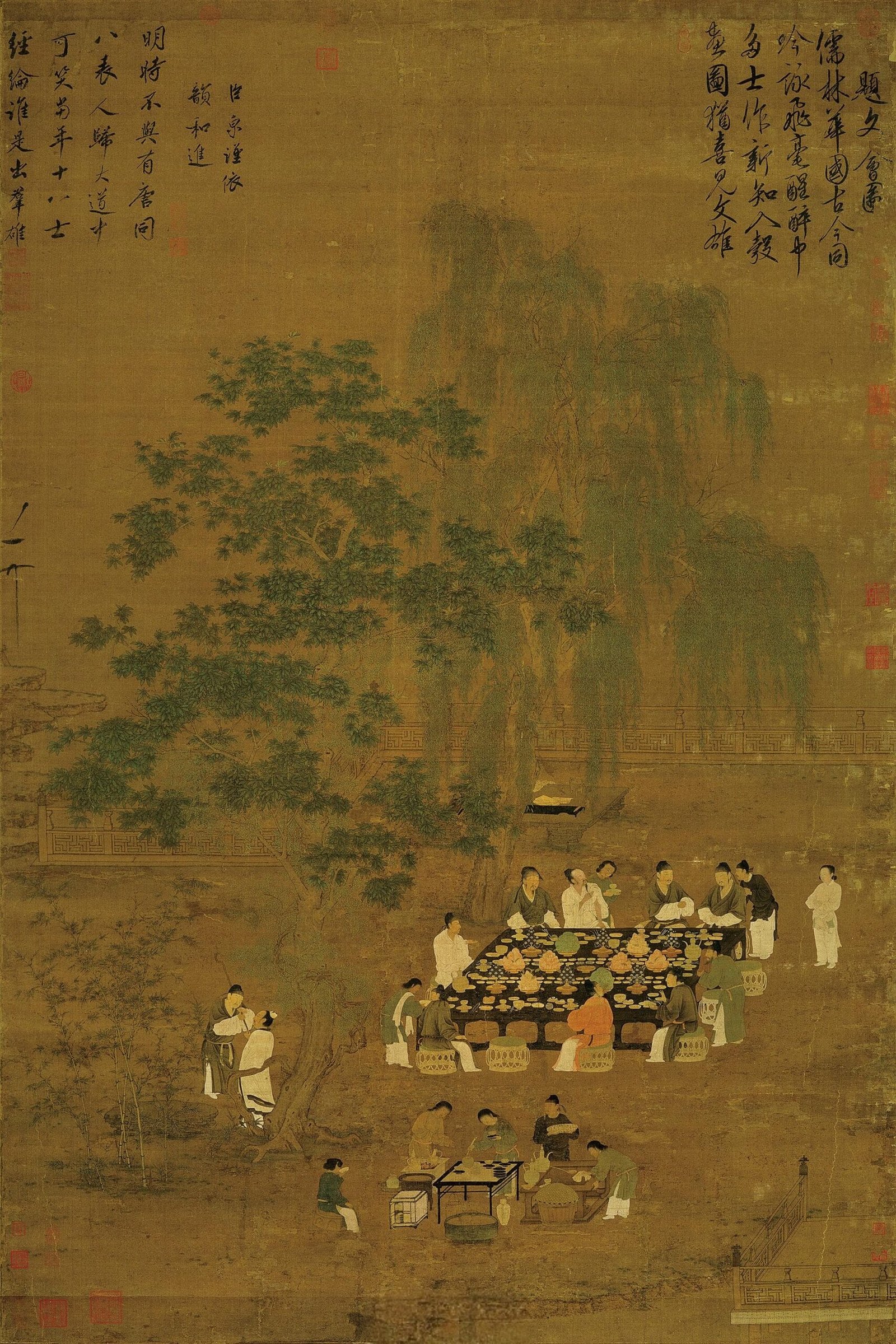
The Song Dynasty (960-1279 AD) elevated Chinese Tea Culture to unprecedented aesthetic heights and made it a central artery of the national economy. The method of drinking tea underwent another revolution—from “simmering” to “whisking.” Tea was ground into an extremely fine powder, placed in a tea bowl, mixed with a little hot water into a paste, then more water was added while rapidly whisking with a bamboo “chasen” until a rich, white, long-lasting foam was created. This skill was called “Dian Cha,” and the game of competing over foam color and persistence was “Dou Cha” (tea contest).
Emperor Huizong, Zhao Ji, was himself a master of “Dou Cha” and a tea theorist, authoring Treatise on Tea. Following the imperial example, whisking and tea contests swept the nation, from the court to the common streets, driving tremendous development in related industries like tea processing (especially steamed cake tea that produced white foam) and black-glazed Jian ware bowls (ideal for observing the foam). However, historians often note that this artistic emperor’s extreme obsession with tea was, in a way, a reflection of the Northern Song’s declining national power.
Economically, the Song established a comprehensive “Tea and Horse Agency” and a tea monopoly system. The state controlled the tea trade, using tea from Sichuan and Jiangnan to exchange for warhorses with tribes like the Tibetans, Uighurs, and Western Xia. This famous “Tea-Horse Road” became a lifeline for the empire. The Tea Trade directly supported national defense (acquiring horses) and finance (gaining tax revenue and goods). Tea became a more critical strategic commodity than silk or porcelain. A leaf had truly become the “green gold” supporting the empire’s operation.
3. River of Silver: The Rise of Global Tea Trade & Geopolitical Games
In the early Ming Dynasty (1368-1644 AD), the founder Zhu Yuanzhang, of humble origin, deemed the Song whisking method too extravagant and cumbersome. He decreed to “abolish cake tea, promote loose-leaf tea.” People began brewing loose leaves directly, which greatly simplified tea drinking and spurred new processes like pan-firing. Most of the Tea Varieties we know today, like Longjing and Biluochun, saw their processing methods finalized and their fame soar during the Ming and Qing periods. Meanwhile, to facilitate long-distance transport and trade with Mongolia and Russia, the technology for compressing tea into bricks and cakes was perfected.
The global story of tea reached its climax after the 16th century. Tea first reached Europe via Arab and Portuguese merchants, initially regarded as an expensive, mysterious Oriental medicine. It wasn’t until the mid-17th century, when the Dutch East India Company introduced tea as a commodity to Amsterdam and created the practice of adding milk and sugar, that it swiftly captivated the Dutch aristocracy and then swept across the European upper class. In Britain, tea sparked a national craze. From Queen Anne to ordinary maids, afternoon tea became an unshakable social ritual. Chinese porcelain (teaware) consequently became a household necessity and status symbol in Europe.
The enormous demand created an enormous deficit. Europe, especially Britain, had almost no goods that the Chinese market needed in large quantities. To pay for tea, European silver flowed into China like a tide. This continuous outflow of silver became a significant burden on the British economy in the 18th century and is considered one of the important economic backgrounds for Britain’s later attempt to balance trade by dumping opium into China. A tiny leaf thus leveraged the flow of global silver, reshaped the world economic order, and sowed the seeds for major historical conflict.
4. Secret & Spread: The Guarding, Theft, and Global Rooting of Tea Craft
Chinese dynasties throughout history, fully aware of tea’s economic and strategic value, regarded its core cultivation and processing techniques as top state secrets. The export of tea seeds, seedlings, and skilled tea workers was strictly forbidden on pain of death. This “Green Wall” protected China’s tea monopoly for a millennium. However, the enormous profit诱惑 spawned one of history’s most famous acts of “commercial espionage.”
In the mid-19th century, to break dependence on Chinese tea, the British East India Company commissioned Scottish botanist Robert Fortune for a top-secret mission: infiltrate China’s interior tea regions, obtain high-quality tea seeds and seedlings, and learn the complete tea processing methods. Fortune shaved his head, dressed in Chinese clothing, and ventured deep into the tea regions of Anhui, Fujian, and Zhejiang. He meticulously recorded climate and soil, observed picking and processing, and ultimately succeeded in stealing tens of thousands of tea seeds, numerous seedlings, and recruited eight Chinese tea workers.
These “spoils” were shipped by sea to India in specially designed Wardian cases (early greenhouses). The seeds were sown in Darjeeling, Assam, and other parts of India, with the Chinese workers guiding the initial cultivation and production. Although Indian tea initially paled in flavor compared to Chinese tea, through technological adaptation and industrial-scale planting, a massive tea industry eventually took root in colonial India. China’s tea monopoly was彻底 broken, fundamentally altering the global tea production and trade landscape. Fortune’s mission is a controversial turning point in the History of Chinese Tea, marking the shift of tea knowledge from closed heritage to global dissemination.
5. Heritage & Renewal: From Ancient Roads to Modernity, The Unfading Aroma of Tea
Despite tea cultivation spreading worldwide, China, as the birthplace of tea culture, has never lost its status or charm. Traditional Chinese Tea Culture is experiencing a vibrant revival in the modern era. People don’t just drink tea; they learn to “savor tea,” using the Gongfu tea ceremony to meticulously experience the myriad variations of different Tea Varieties (like Oolong, Pu-erh, Black Tea). The health benefits of tea are also continually validated by modern science, from antioxidants to mood relaxation, connecting the ancient beverage with contemporary wellness.
Today, China remains the world’s most diverse and skilled producer of tea. A cup of Wuyi Rock Tea, a cake of ancient tree Pu-erh from Yunnan, or a sip of pre-Qingming Longjing from West Lake contains not just flavor, but the accumulation of millennia of Chinese Tea History, the crystallization of specific terroir and generations of craftsmanship. Together with Indian Darjeeling black tea, Japanese Uji matcha, and Sri Lankan Ceylon tea, they form a rich and colorful world tea map. Yet, tracing back to their Origin, all their stories are intimately connected to that miraculous leaf from China.
Conclusion: Your Teacup, an Echo of History
Next time you cradle a cup of tea, be it a fragrant white tea or a mellow black tea, take a second to feel the weight of this gift. What you hold is more than a hot beverage. It is a civilization’s messenger traversing forty-seven hundred years, a hard currency once equal to coin, a strategic commodity that stirred imperial anxiety, the caravan bells crossing snowy mountains and deserts, and a cultural bridge connecting East and West.
This leaf witnessed Shennong’s discovery, Lu Yu’s craftsmanship, Emperor Huizong’s obsession, Zhu Yuanzhang’s reform, and also endured Fortune’s theft and global transplantation. Its history is half the chronicle of globalization. At JunxiTea, we believe understanding the past of this leaf allows you to better savor its present. Every tea we meticulously curate carries a unique story of terroir and heritage. We invite you to start with a cup and taste this still-vibrant epic of Chinese Tea, a story that has journeyed through millennia.